

So to Speak
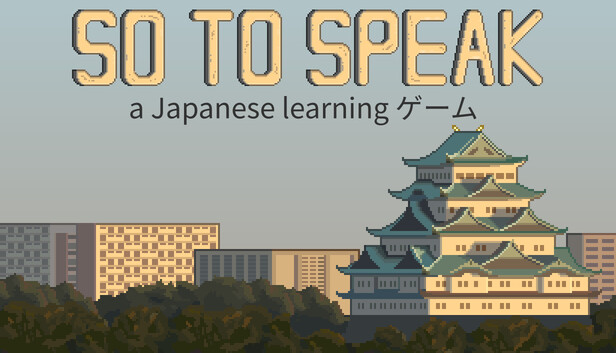
So to Speak is a Japanese language-learning game where you have to match the correct word with its corresponding object. It is probably the best language-learning game I’ve ever played (take my words w/ a grain of salt anyway, since I’m not actively seeking language-learning genre in general.)
The game does it right in many aspects. The first notable one is the concept of “listen first, read later,” not the other way around. Another is that it presents the language in the order that most of us players will encountered in real life: travelling to Japan for pleasure — unlike other “serious” games/books that revolve around working culture, drill down too deep too early (like teaching a huge family tree from great-grandparents to second cousin twice removed), or solely focus on 敬語.
In this game, you’ll slowly build up your vocabulary alongside a bit of simple grammar. The vocab is around N5 level and covers your basic day-to-day life, which is quite adequate if you’re planning to visit Japan for a week or two.
Now– if you’re equipped with some knowledge of Japanese –heads up that in this game, some kanji doesn’t have its corresponding reading, and some spoken word doesn’t have a corresponding kanji (only kana available). For example, there is no kanji 見 that directly links to the meaning of “see”; however, this kanji exists accidentally(?) as a proper name, so you can use it to match the word “see” anyway… This might annoy some who wish to tag all the words (like me lol), but I guess that’s a quirk of language in the real world: you’ll occasionally encounter hapax legomena.
This relaxed-matching also comes with a downside: it might accidentally match homonyms. For example, a word like “like” in the context of “it looks like” can be matched to 好き; or the English particle “to” can be matched to と.
Despite that, the game is fun and functional. It still has room for improvement, IMO:
First, the dictionary on the right panel of the screen could use a redesign. Right now, it’s not quite acting as a “dictionary,” but more like a collection of every conversation & signage instead. So it’s quite hard to find the word you need despite having the “search” box.
I think this dictionary could be better split into 3 tabs:
- conversation: records every convo/sign in chapter order (the current behavior);
- dictionary: records only words, like a traditional dictionary;
- favorite: a blank page for players to pin the words themselves.
The favorite page will likely solve many issues in the game and let the player tackle it with their own technique. For me, I’ll use that page to record common words and all of the particles, so when I hear a sentence:
「さくらははるにぴんくいろになるよ。」
I’ll try to match the particles first in order to structurize the sentence (and not mistakenly tag はは as 母, LOL). So the structure becomes:
「さくら は はる に ぴんく いろ に なる よ。」
Which is now clearly:
「桜は春にピンク色になるよ。」
Secondly, the game is not quite serious about matching the exact word. In particular, Japanese has 〜ある and 〜いる, which convey very similar meanings but have a subtle different rule on how to use (likely comparable to “be/is/am/are” in English). Maybe–just maybe–this needs to be matched exactly for players who wish to seriously learn the language (maybe a “hard mode” will do).
Lastly, the game sometimes interprets a natural Japanese sentence into a natural English sentence. This, of course, makes the sentence sound natural. But it also loses the language’s nuance. For example:
「お母さんに電話をかけているよ。」
Is translated to:
“I am talking to (my) mother.” — losing the phone part.
While this is perfectly fine in translating something for mass media, in the context of language-learning, I don’t think it works… Instead, I think the learner should embrace weird translations that keep nuance intact as much as possible.
I’m more than thrilled to see DLCs for this game (which might expand the vocab to N4~N3, more grammar, or a variety of daily life scenarios, e.g., police station, doctor’s appointment, a date w/ to-be waifu, etc.)
頑張ろう、みなさん!
Originally published on: Steam

author